Sunday, 29 January 2023

JANUARY 2023 - Uncommon to rare species found this month. Nine new to County.

I'll start with my most recent trip which took me to Devon and Offwell Woods, located just south of Honiton. Here I found a delightful habitat of two interconnecting streams creating a mossy damp local climate which tends to attract all sorts of fungi. Here was no different as when I was about to depart I noticed a large white vertical wall of a polypore type resupinate growing inside a cracked stump which I assumed to be Pinus, as I know the woodland is predominantly of this species. After examination at home this became Antrodia carbonica, only the 4th record for the UK after being first found by Prof. Fortrey in 2011. Mostly found in the USA, the key here was the flesh or context turns very quickly blue/black with Melzters staining, along with amyloid walls to the skeletal hyphae and the spores remaining neutral. The spores were accurate also and I was able to obtain a spore print. I would send this type of record for sequencing but finding a reliable source these days that won't take six-months to check, if at all, is very difficult. You can pay of course and normally overseas as it appears the amateur mycologist always goes to the back of the queue. Sad, but this is the way at the moment yet to me this is where most new species are found as we are constantly looking whereas many of the professionals tend to revaluate old records, re-sequence and move taxonomy around. Has to be done, but the foot soldiers don't get supported as well as they should - In my opinion!!

Others this month included myxomycete Badhamia foliicola on Pyrus (new to Gloucs.), Camarops polysperma on Fagus at Ebworth NT Estate (also new) and the best of all an agaric still fruiting in the middle of January in a damp marshy area near Frampton-on-Severn by an Oak plantation. This had lost most of its colouration, but the remaining macro and micro details, included odour told me this was Dermoloma pseudocuneifolum (again new to Gloucs.). At woods east of Duntisbourne I found a large ancient Ilex (Holly) tree and so spent some time around this tree as expected something different from this unusual lovely specimen. Firstly I found Diaporthe crustosa, a plain and simple ascomycete and then a jelly type fungus on a detached branch hidden within the tree itself containing Exidiopsis opalea (new for Gloucs. and well beyond). At Cirencester Park I found the uncommon Hypochnicium bombycinum on Abies alba as well as the rarer Trechispora dimitica with its tiny spiny cut away spores (New for Gloucs.). Also here was my second finding of a new species for the UK I found two years ago thanks to the ID of Paul Cannon (Kew) now called Schizoxylon sp. 4600! The string shaped spores are much smaller than all other known species of this genus. On Abies alba this time. My first visit to the nearby NT site at Crickley Hill near Birdlip on a wet and misty day still produced Karstemia rhopaloides on Blackthorn followed by a visit back to Ebworth NT where I found the tiny almost invisible clustering Merismodes anomalus on Quercus near a stream as well as the Pyrenochaeta fallax ascomycete (new for Gloucs and all Sth West also). Back at the woodland near Duntisbourne but this time on Pinus, I located the Jelly fungus Phaeotrella frondosa and close by as as expected also on rotting Pinus was Tubulicrinus subulatus. Seen before but uncommon all the same. Most grey almost non-existent 'fluffy' resupinates on rotting branches of Pinus are of this family, so worth taking a look as they possess incredible Lypocystidia which are unlike most. So considering we had a cold spell with snow during this month, fungus is alive and well in winter if you keep on looking. Luck helps also! 

On the last day of January, I also found an uncommon resupinate in Athelopsis glaucina, helped by thin allantoid spores in Cirencester Park once again. New to Gloucs.

Antrodia carbonica

Antrodia carbonica blue/bck in Meltzers


Antrodia carbonica on Pinus

Antrodia carbonica spores

Badhamia foliicola

Camarops polysperma

Dermoloma pseudocuneifolum under Oak

Diaporthe crustosa

Exidiopsis opalea

Karstemia rhopaloides ascospores

Karstemia rhopaloides

Merismodes anomalus

Merismodes anomalus x40

Phaeotremella frondosa

Pyrenochaeta fallax

Schizoxylon sp 4600 (Kew)

Trechispora dimitica

Trechispora dimitica spores

Tubulicrinus subulatus Lypocystidia
Athelopsis glaucina spores
Athelopsis glaucina

Tubulicrinus subulatus


Wednesday, 4 January 2023

DECEMEBER 2022 - Uncommon to rare species found during the month.

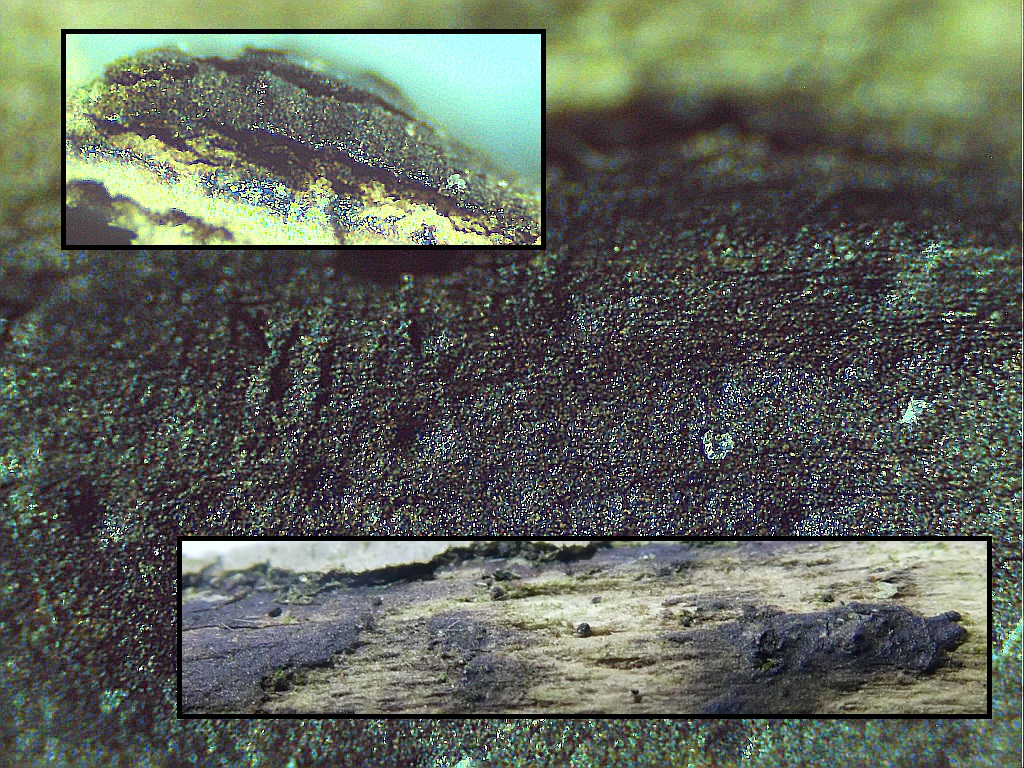
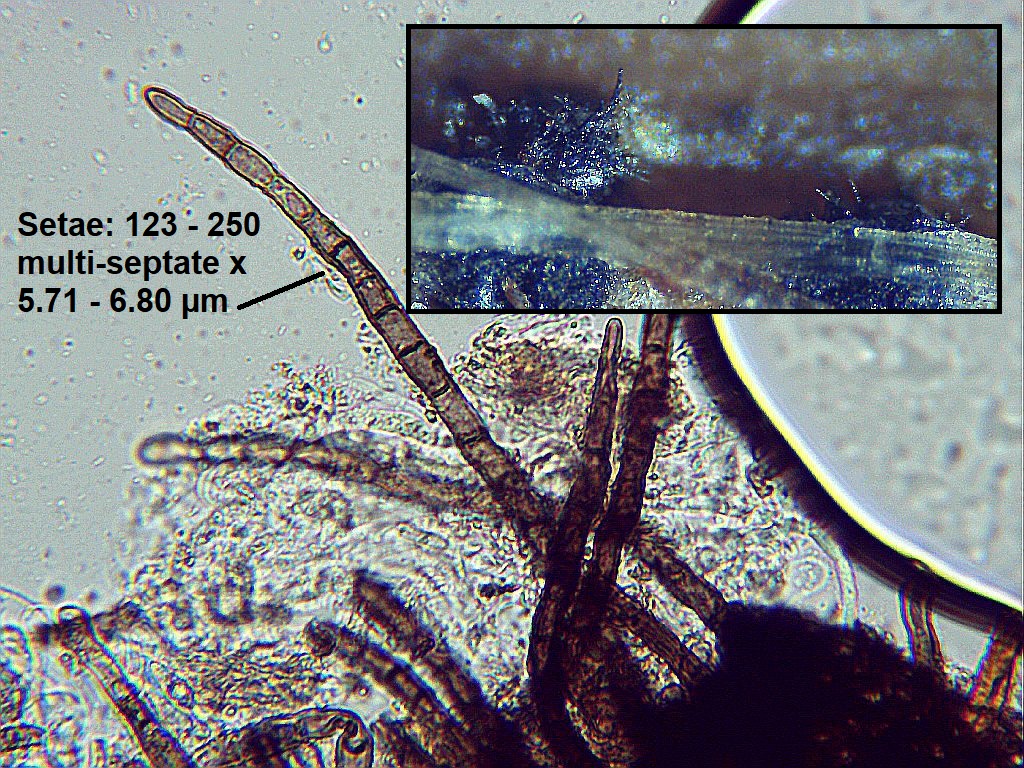
Well November was good with ten new species for different counties so another six in this month was even a bigger surprise and some interesting species to boot! This was during a month when nothing happened due to a severe cold spell with heavy snow taking a week to disappear so making fungi hide for even longer. If I was a Mycena would I burrow out into the cold knowing there wasn't any foolish odd-ball fungi finder looking for me - of course not. Fortunately. Then we had Christmas - how else am I supposed to get new Fungi books? A short visit to my local patch at Bowbridge fields is where I found on a dead herbaceous plant base Acanthophiobolus helicosporus showing a few vertical setae from a minute asco body hiding between rows of common ascos. 2nd for Gloucs., but again probably not rare as maybe just a few people study these in the field with a hand lens. Also here living off a head high Salix branch on moss helped fix my eyes on the diminutive Chromocyphella muscicola. Looks so small, so easily mistaken for something to be ignored and virtually gill-less. On the same Salix tree a small resupinate growth suggested it should be looked at, especially as hidden in crevice of the branches and close to water. At home this emerged to be Eichleriella deglubens which has large allantoid spores. Whilst visiting my sister-in-law in North Wilts I took a walk around the farm where she lives. Picking up some maize stem debris from earlier in the year I found Gibberella zeae at the root of the plant. I let the farmer know what I had found in case he needed to know, I didn't get a Xmas Card so maybe that was his answer. 1st report for Wiltshire though! At Painswick Beacon among the Pinus and Fagus on the heathland, I found a modest looking smooth grey resupinate. This showed small warty globose spores - a very helpful guide to where to go, as well as other detail which made Hypochnicium punctulatum - 1st for Gloucs. Nearby in parkland under Boxus but on a stump of something else long ago was a cluster of Lachnum fasciclare. Always difficult to ID, especially when 'they' keep changing its name. Narrow lanceolated paraphyses and short hairs helped. Few county records. Back to the Salix at Bowbridge and the same tree produced a tiny white with basal disc Mycena. Careful study showed this to be Mycena clavularis - few records in Gloucs. Probably more common than perhaps records show as it is just so easy to dismiss. A trip back to my survey site at Ebworth NT Estate just before heavy snowfall was due paid off. On Alder/moss living branch near a stream I found the pale yellow ascomycete Parorbiliopsis minuta followed by a walk into nearby natural grasslands which had all the signs of past farming techniques with shelf type agriculture methods on banking evident. Here I was delighted to find a rare winter growing agaric species in Pseudoclitocybe expallens - similar to its look-a-like but which is found in woodlands. This also has its own detailed differences with mature specimens having inrolled crimped margins, unclamped and granular hyphae content as well as spore size and shape. New for Gloucs. and few other UK records. Lastly, venturing into a wet woodland by another stream (the Cotswolds are fortunate to have many springs starting within the many limestone based woodlands) I selected what appeared to be a Fagus rotten branch finding a dark looking resupinate. After the usual checks at home this turned into Tomentella badia - new for Gloucs and with only 20 others UK records. This genus is one of the hardest to decipher with very little differences between the many species - if you can find them as none are common. With this one I got lucky as it is one of the few without any clamps and the subhymenial hyphae turns blue in KOH. An irregular shaped warty mix of subglobose spores also helped. I look forward to the warmer weather in January 2023 as predicted and wonder what will be happening to fungi when the ground is harder or softer at times of the year they don't expect. No doubt they will adjust but might take a few years when early or late growth patterns start to emerge. They have already to me. I saw virtually NO waxcaps in and around Gloucs. this year - something I find astonishing. Hopefully they are having a break as other times they all come out at the same time. There seems to be an acute lack of Russulas also this year so I hope this also will change. 

Acanthophiobolus helicosporus

Chromocyphella muscicola growing on moss

Chromocyphella muscicola

Eichleriella deglubens

Gibberella zeae on Maize


Lachnum fasciclare x40

Mycena clavularis

Mycena clavularis

Parorbiliopsis minuta asci

Parorbiliopsis minuta

Pseudoclitocybe expallens 

Pseudoclitocybe expallens

Pseudoclitocybe expallens cuticle

Tomentella badia

Tomentella badia spores x1000

Tomentella badia hyphae changes


Friday, 2 December 2022

NOVEMBER 2022 - 10 new species for Gloucs.!! ... and other uncommon to rare species identified.

And I thought October was good - this month the Fungi Fairies (and Elves!) were on my side as I found and identified TEN new species for Gloucs., along with quite a few nearly new also making 22 species to discuss here this month. Towards the end of the month the agarics were disappearing fast but new fungi kept appearing in meadows, low grassy patches, etc., almost anywhere. 

Going through these alphabetically I will start with a tiny clustered ascomycete found on an ex-bonfire site, extensive growth pattern shows a golden pigmentation in the swollen tips of the paraphyses and spores showing 2-guttulate content. This is Anthracobia macrocystis and found in Silk Woods near Tetbury. Few records in Gloucs. While visiting Minchinhampton Common at the beginning of the month I was aware that the Helianthemum mounds are very productive here and sure enough two turned up in a solitary state. The first turned into Cortinarius rubicosus, new for Gloucs and few other UK records. The gills are distinctly distant, KOH neg. on the cap and matching spores - very important in Cortinarius. Just a few metres away an Inocybe species was growing atop another mound, this one even better as became Inocybe slendens var. splendens, the rarer species than most which tend to be var. phaeoleuca. 2nd rec for Gloucs. Back to Silk Wood and this time in a patch of partially removed woody debris and woodchip from a variety of trees on the ground was Crepidotus autochthonus - rarely found but still only 4th for the County. In sheep fields NW of the Ebworth Estate I am surveying this year, I found a diminutive Coprinopsis species on dung. This turned out to be C. stercorea after careful studies under the microscope and the veil structure. New for Gloucs. In the same fields and day, also on dung I found the very tiny orange/yellow asco in Cheilymenia pulcherrima - new for County and also most of Southern England. Few records elsewhere. This takes some finding as being so small unless you study a lot of dung closely, then it will be missed. Fortunately, there was no one else around so I wouldn't look strange to many, mostly always dog walkers. I am thinking of taking around with me a large toy dog, just sits there looking at me, perhaps robotic and twitch its tail occasionally, then most other folk I meet wouldn't give me such suspicious looks (even though I look suspicious). At one of my favourite haunts at Cirencester Park, in and around the roads to the Polo Club (I couldn't play today as I left my mallet and horse at home and wasn't selected anyway!) walking through grasslands close to the forest edge I came across a very large Entoloma species. This turned out to be E. turbidum - new for the County. Entolomas can be very difficult to ID, most having no cystidia on the gill edge and not a lot more to go on other than the spores. But with careful examination, the spores are the clues. There are five types in shape - get this right and the macro description then you are not far off the identification. Clamps on the basidia also helps, if you can find them! Large allantoid spores, longitudinal basidia, IKI- and spores size proved a smooth grey looking resupinate (looks like 50 others) proved to be Exidiopsis calcea. This being 4th for Gloucs, but after my 2/3rd before! Odd. Galerina sideroides as found in Cirencester Park and at the same location Helvella crispa - included here as just really looking quite wonderful in this photo. Not uncommon. Also here an Inocybe posterula was located under Picea. Note I check all three cystidia types in Inocybes carefully before coming to a conclusion. 1st for Gloucs. Another Inocybe was found back in Ebworth, this one with Fagus and became I. margaritspora. Exploring the grasslands at Cranham Common would be new for me, but I found Lactarius evosmus (I had already located this species on Minchinhampton last year). Appearance alone should be enough to identify this species but to make sure then taste the milk but it will make your tongue sore for a few days - but you know you have the right species!! Very acrid. Here also on Cow dung I identified Paneolus subfirmus - looking like many other psathyrella species, but the microscope doesn't lie. 1st for the County. Back in Cir. Park near a fallen Fagus tree, growing in leaf litter was a fungus that blackens, especially on the gills with the slightest touch. This was Lyophyllum leucophaeatum - 1st for Gloucs and all West Midlands. Back to Ebworth, this time in the SW beech woods where I didn't find a great deal except one species growing off a fallen log. This had quite a conspicuous macro and was Marasmiellus foetidus. Normally foul smelling, well I didn't find out as looking was good enough (plus the microscopy of course). 1st for Gloucs and only 9th record in UK. At a wonderful small nature sanctuary just off the main Stroud road and all within 20 metres of each other I first found Lyophyllum fumosum (few records), then a large cluster of orangey/yellow/brown agarics growing on a large woodchip pile, probably mostly from broadleaf trees. This turned out to be the very rare Pholiota lucifera and new for the County and most of Central and SE England. Nearby, was the uncommon Psathyrella noli-tangere, looking nothing like a Psathyrella! Lastly, (still more) was the uncommon coral fungi Phaeoclavulina flaccida (was Ramaria) and an even more unusual jelly fungi Pseudohydum gelatinosum - not uncommon (new to me) just good to see! Finally I also picked up here the tiny spindle type fungus Pterula gracilis. Phew ... time for some pics.

Athracobia macrocystis

Cheilymenia pulcherrima

Cheilymenia pulcherrima on Sheep dung

Coprinopsis stercorea veil

Coprinopsis stercorea

Cortinarius rubicosus on Helianthemum

Cortinarius rubicosus spores

Crepidotus autochthonus

Entoloma turbidum

Exidiopsis calcea

Galerina sideroides

Galerina sideroides

Helvella crispa

Inocybe margaritspora

Inocybe margaritspora

Inocybe posterula

Inocybe posterula

Inocybe splendens var. splendens caulo.

Inocybe splendens var. splendens

Lactarius evosmus

Lyophyllum fumosum

Lyophyllum leucophaeatum

Marasmiellus foetidus

Marasmiellus foetidus spores

Paneolus subfirmus cheilo.

Paneolus subfirmus

Phaeoclavulina flaccida

Pholiota lucifera

Pholiota lucifera cheilo.

Pholiota lucifera stem

Psathyrella noli-tangere

Psathyrella noli-tangere cheilo.

Pseudohydnum gelatinosum

Pterula gracilis