Wednesday, 28 August 2019

Wilsey Downs Woods, Nr Camelford - 22nd August 2019

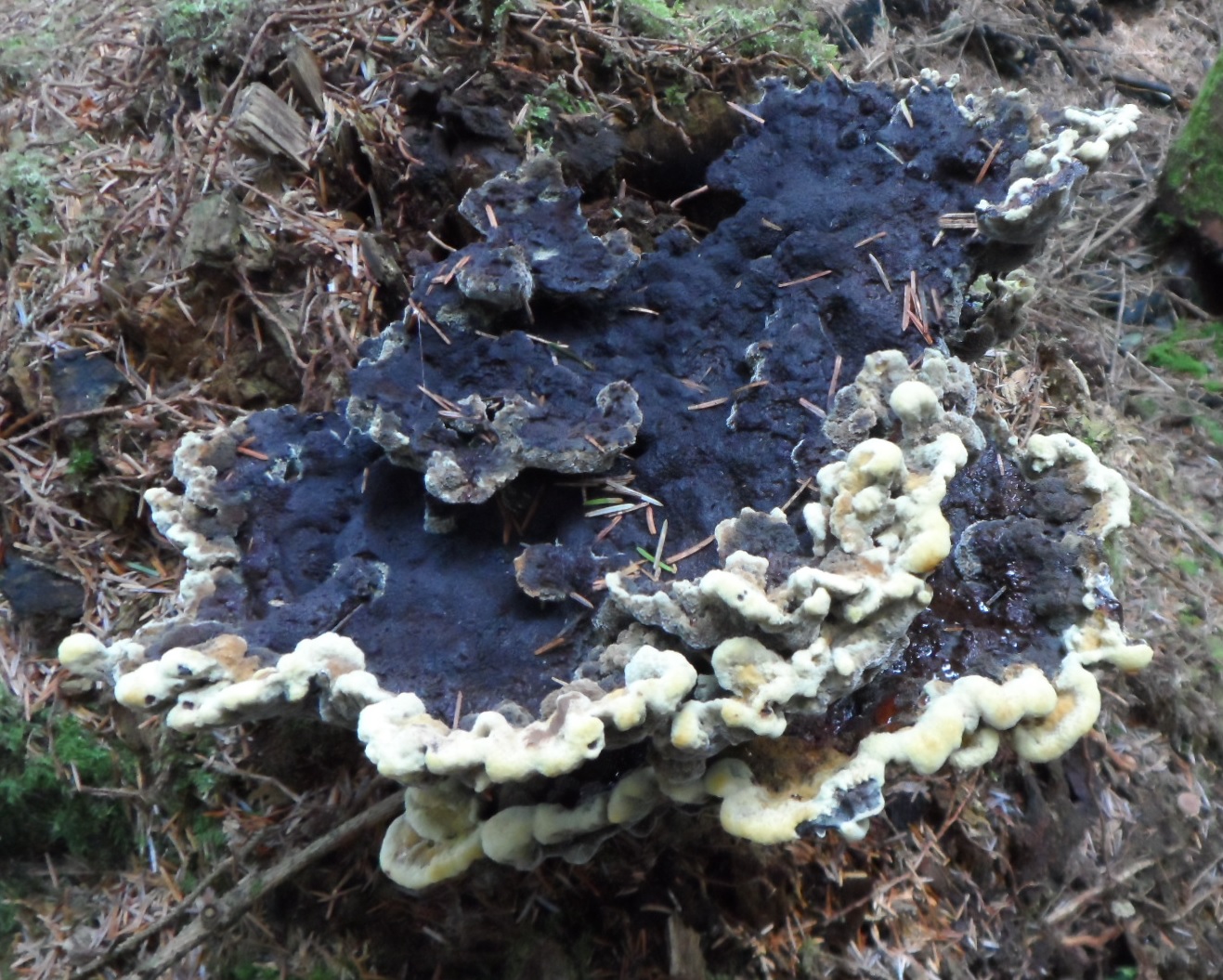
Thought it might be a good idea to go somewhere where I have not heard that many people visit, and being a conifer plantation as well it can be very barren or fruitful. Thankfully, after recent rains had some interesting finds, especially Cortinarius, which evaded me all last year. Walking through what was heavy going due to grasslands being very boggy or tussock filled I came across a very small orange cup species on deer dung. This turned out to be the common Cheilymenia granulata. Deer and grass can mean ticks, so I was constantly checking in this terrain but found none. Time to move on to sensible timber moving tracks and alongside older growth allowed walk-in foraging under good light. There were many Mycena galopus or Milking Bonnets around, with a few var. candida's also showing their lovely pure white conical caps. Quite a few Lactarius turpis, or Ugly Milkcaps also on the needle litter although I find their dark green colouration quite colourful for any mushroom. Moving due east back towards the dog-walkers car park, (there were many who eyed me suspiciously as I didn't have one!) I came across Cortinarius city with three different species on show which were due to give me considerable headaches on returning home. The first, was a singular very slimy cap and stem. Through careful spore examination and macro checks I was able to differentiate this from a familiar species C. stillatitius. This became C. muccifluus, or Slimy Webcap (no surprise there) not very rare but seemed 2nd for county at available data to check. I then picked up the previously mentioned lookalike C. stillatitius also, although getting a little old I relied on macro details only for this, so isn't a definite record. Then along came another solo agaric in C. delibutus. This was also quite difficult to check as being a little mature for a yellow webcap, however, the spores were quite definitive and helped ID this one, considering a fresh example is very yellow.  Several records for Cornwall so not exactly rare but a good find. Moving along the edge of the Silver Firs and keeping in moderate good light (I find moving too far inside darkened woodland decreases your chances of finding fungi) I came across a beautiful bracket type species - quite large around 36cms wide with a soft yellow porous covering on the edge and softer inner blackened main body. This was the only species in this genus being Phaeous schweinitzii, or Dyer's Mazegill. A single Russula although on needle litter was close to stacks of logs, which were probably old cut Silver Birch, as this was Russula betularum, or Birch Brittlegill. A single Phallus impudicus or Comm. Stinkhorn was putting up spores for the flies to disseminate. Lastly, before heading home I came across a first for me in Oyster Rollrim or Tapinella panuoides, with its large rust gills and bracket like attachment suggesting other kinds of fungi. So at this time of the year, a place to find unusual species perhaps, but no boletes which was disappointing. 


Cheilymenia granulata on deer dung

Cortinarius mucifluus or Slimy Webcap

Cortinarius mucifluus
spores

Cortinarius mucifluus gills/stem


Cortinarius delibutus cap cuticle

Cortinarius delibutus
stem/bulbous base

Cortinarius delibutus
large broad ellipsoid

Cortinarius delibutus or Yellow Webcap

Lactarius turpis or
Ugly Milkcap

Phaeolus schweinitzii or Dyer's Mazegill

Phallus impudicus
with fly infestation

Russula betularum or
Birch Brittlegill

Russula betularum cap cuticle cys.

Tapinella panuoides or Oyster Rollrim

Thursday, 25 July 2019

Trelyll Farm track nr St Breock - 20th July 2019

Following a very long dry spell, rain came for a day only and so following this single attempt to hold back climate change I ventured out once again this time heading for somewhere I had never been before. Unusual as it isn't that far from where I live and is shown as a bridleway on the OS map. However I don't think it has seen a horse in decades and I could only just make it halfway before the undergrowth, brambles, etc., covered the track. However, it did uncover some remarkable new species for me and it seems, Cornwall. The first came in the form of a Myxomycete which was found under a log, and displayed the unusual form of tall mesh type fingers with flask type cups acting as the bedrock of the species. Tiny as usual but after some research and spore test it was eventually clear that this was Arcyria nutans. A first for Cornwall from the data you can check with these days. There are many sources of recordings but I mainly follow the BMS data-set and/or FCT. In the same area under another log roll I found a whitish small blobby (sorry mycologist purists) resupinate and after careful examination of spores, etc., this turned out to be the fairly uncommon Bulbillomyces farinosus, but as it has a common English name of Couscous Crust, it can't be that scarce. Around ten records in Cornwall. Nearby on the same log a few very small ochre cups were showing through and these turned out to be the fairly common Bisporella citrina. Alongside these and running down the full length of the substrate were lots of Calocera cornea, or Small Stagshorn. Not content with the many different species I was finding when I had expected little to none when I set out, the clue was a full flowing stream nearby which was keeping the area damp. On another branch on the ground I found another resupinate this time a greyish thin body and looking like every other resupinate you come across. After painstaking checks at home with good results for spores, cystidia and other factors I had narrowed it down to the uncommon Hyphoderma argillaceum. After checking with Pauline Penna (CFRG) she highlighted the slight spore discrepancy and following her advice to check for cyanophillie or blueing of the spores, this was confirmed as the equally uncommon Hypochnicium erkssonii. Still a first for Cornwall once again. Moving further up the track, still unaware of the good finds already made, I fought my way into the last reaches of the track before being engulfed in plantlife. Here I spotted a fallen tree and noticed some Oysterling type fungi in large quantities. This was the common Crepidotus mollis or Peeling Oysterling. However, this had taken me into a dark area of the woodland, where I just about hung onto various branches otherwise would plunge down the steep incline into the stream. Whilst avoiding this fate, I still managed to spot one of Cornwall's favourite finds these days in a small collection on a small twig on the ground of the ever impressive Ping-Pong Bats, or Favolaschia calocera. Always good to find. At the same spot I uncovered a small branch on the ground covered in a resupinate covered with tiny teeth. Once again after careful examination later I found this to be the uncommon, well for Cornwall, Mycoacia fuscoatra. Probably 2/3rd for Cornwall. Previously known as Phlebia f. Lastly, on the same tree I found a large quantity of young fungi growth of Xylaria polymorpha, or Dead Man's Fingers. This showing the smooth grey state not often seen, rather than the bulbous blackened normal mature examples. So for what appeared to be just a look at the wild flowers turned into quite a haul of good species and I'm sure this location will show new fungi in the Autumn also as the area seemed to be a forgotten path through a smattering of old ancient woodland and a disused old quarry.


Arcyria nutans myxomycete - 1st Cornwall

Arcyria nutans x40

Arcyria nutans spores
and hyphae band

Bulbillomyces farinosus

Bulbillomyces farinosus
spores

Favolaschia calocera

Favolaschia calocera spores

Favolaschia calocera cystidia

Hypochnicium erkssonii - 1st Cornwall

Hypochnicium erkssonii spores

Mycoacia fuscoatra

Mycoacia fuscoatra spores

Xylaria polymorpha - Dead Man's Fingers

Calocera cornea


Friday, 21 June 2019

Mid-Summer finds various locations - May/June 2019


This time of the year it's unlikely to find a great many species of fungi especially when most of May and beginning of June was so dry. I aimed for wetter places to visit, unsurprisingly, and so still managed to locate one or two interesting agarics. In early May I found myself in Lanhydrock woods (near Bodmin) and thought it had been a wasted journey until I searched a cut wasteland of ex-conifer plantation. Here a splendid and recently 'hatched' Phallus impudicus appeared. On 1st June I headed for Breney Common, known for its ponds and marshy areas, also good for wild flowers as this is another pastime I follow in the summer months. Again, not much around and also slightly desperate when you are turning logs to see if there is an asco or myxo about. Walking into a drying up pond, as it had been so hot for some time, I was able to walk around the surface but spotted a few mushrooms growing on Sphagnum. This turned out to be my first Sphagnurus paluster or Sphagnarum Greyling. Recently renamed from Tephrocybe palustris. On 10th June, I decided that wild flowers would be the best natural world species to aim for as I was heading for The Lizard, one of the splendid places in Cornwall which hold all sorts of rare plants. I wasn't disappointed and found some very rare flowers but I won't go into that here! I ventured out onto the heath land and moor at North Predannock Downs, about 5 miles north of The Lizard. This is a CWT location but to enter the site isn't easy and you have to find the only gate in about two miles of track that even a fox would find difficult to find. Once moving around the moor, I located on some horse dung very small fungi emerging from the substrate. On closer but short observation! this turned out later under the microscope to be Parasola misera, or Least Inkcap. First for me and one of only a few records for Cornwall. Finally, for this report and on 15th June I headed to my local patch at Hawkes Wood. I found an early bolete in Xerocomellus chrysenteron, not rare in itself but certainly uncommon to be seen so early. Perhaps the heavy rain at mid-June helped the fungi to suggest it was now or never- so let's go. I traced myself back to a fallen tree I had found a very rare Xylaria sps., Xyalaria cinerea, early in the year. On checking the site I found these young specimens spouting well across the tree, so added these here as the mature fungi is difficult to see but these white headed youngsters are even rarer. Moving onto 17th June I visited my other local patch at Treraven Wood, owned by the Gaia Trust, whom I am now helping out with ID for species found at the site. Here I located another Stinkhorn, two in fact, plus more interestingly a 'LBJ' of the fungi world in Entoloma hebes. This is a small typical nondescript looking mushroom, but with a distinct spore arrangement which helped guide me to this species. Lastly, at my favourite woodchip pile I found for the first time here and for me Psilocybe cyanescens or Blueleg Brownie. A hallucinogenic species to be avoided. I recorded an African Elephant on the way back to the car, then thought back I shouldn't have sniffed that fungi.
Phallus impudicus - Stinkhorn

Sphagnurus paluster - Sphagnarum
Greyling

S. paluster spores

Parasola misera - Least Inkcap

Parasola misera

Xerocomellus chrysenteron -
Red-cracking Bolete

X. chrysenteron

X. chrysenteron spores

Entoloma hebes - Pimple Pinkgill

Entoloma hebes

Entoloma hebes spores
Xylaria cinerea - immature growth

Psilocybe cyanescens - Blueleg Brownie


Wednesday, 8 May 2019

Bowithick bog and Penpont river - 5th May 2019

On a clear and beautiful early May day I went recording with the Cornwall Fungus Recording Group once more, this time at a place I have never been to, but one I will certainly return to. What a delight. Middle of nowhere but plenty of parking, unheard of in Cornwall for out of the way places to record. I was hoping to find something new here and wasn't disappointed as within meters of the cars and almost the first bog we looked into, Mitrula paludosa or Bog Beacon was found, with many more in the vicinity. Just after this and in my eagerness (stupidity, I think I heard someone say) to see more I went knee plus down into the bog and had to pull myself up across the surface. I had only just begun the day! Still it dried out soon and it took longer for my pride to return. Still alive, we continued across the moorland following the boggy area as we went. Looking closely at dung often brings surprises, this time showing a Cheilymenia species, probably fimicola after checking the septa. The common Phanaerochaete sordida resupinate was found by Pauline on gorse but as for most white bland resupinates this needed checking under the microscope. A nice fat black horse leech was found nearby - never seen a leech in the UK! Walking out onto the moor I found the common Stropharia semiglobata or Dung Roundhead. Polyporus brumalis or Winter Polypore was surviving the winter still up here on the moor and found on Hawthorn along with Turkeytail. It was on the return journey and heading for the all important lunch box, that I came across some very small agarics on a grassy bank near to the boggy area seen earlier. These looked like Entoloma at first but after much checking through microscopes afterwards by the group, Pauline had found an Arrhenia species. This caused some confusion as A. griseopallida is very similar to A. obscurata, the latter having a tapered up stem, whereas the former is the opposite. Other features suggested the former. Following extensive tests at Kew, this proved to be the rarer of the two and A. obscurata. 3rd for Cornwall. Moving on down past a line of willows over the start of the River Penpont we didn't find a great deal until Pauline went wading in the river and pulled out a stick with little 'orange blobs' on it. This was recognised as a rarely seen ascomycetes sps. Vibrissea truncorum, probably because not everyone goes wading in rivers! Probable 1st for Cornwall.


Mitrula paludosa - Bog Beacon

Mitrula paludosa spores

Stropharia semiglobata -
Dung Roundhead

Stropharia semiglobata spores

Arrhenia obscurata - one of two sites found for this rare species

Arrhenia obscurata

Arrhenia obscurata

Arrhenia obscurata spores

Vibrissea truncorum - aquatic sps.