Thursday, 14 May 2020

May 2020 - local walks still produce some interesting fungi

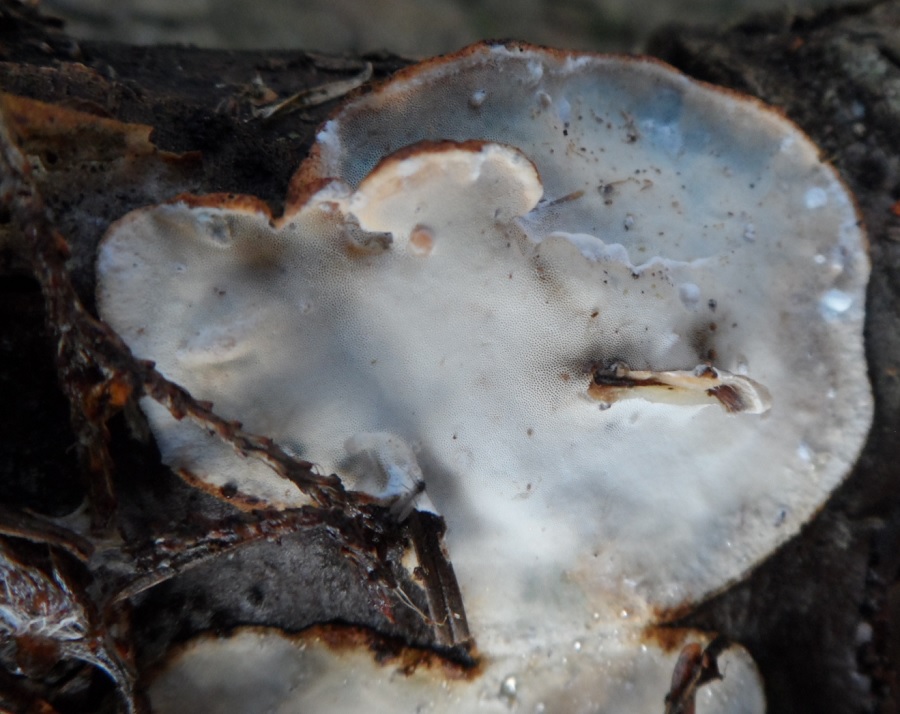
Being restricted to where we walk during this time, I took advantage and to assist the isolating spacing I went to very isolated footpaths or woodland where in all the trips I made I didn't see another person. I did still come across one or two interesting species to record here. In early May I went along a new footpath to me north of Lemail Farm and SW of St. Mabyn, which must be one of the best kept secrets in my area. Beautiful spring wild flowers everywhere, I even came across a rare species, not just for Cornwall but generally in Cardamine bulbifera or Greater Cuckooflower. Just before finding these flowers I explored one of the many woodchip [piles found at this site). I love woodchip. Always pops up surprises and no more than in the spring. Here I found a Pluteus species showing dark brown edging to the gills and a dark brown velvety cap. Later this keyed out to be Pluteus luctuosus, only 2nd record for Cornwall. Later, the following week, I returned to my local patch at Hawkes Wood (a Cornwall Wildlife Res.) and before entering the woodland a woodpile presents itself to me on every visit, someone somewhere taking away but replenishing at all times of the year. I was astonished to see this time a 20 or so growth of fruiting Agrocybe rivulosa. Something I have seen on woodchip before in Cornwall and until only recently was quite rare. It appears to have come into this country via imported woodchip from Europe and is just uncommon now rather than a rarity. Also found here was a resupinate, one that under the microscope observed long thin spores, unusual and so the aptly named Subulicystidum longisporum was quickly recognised. Fairly common. Time to go to church I thought, every prayer counts these days and I mean that. I went along to the beautiful isolated church at St Breock, walking distance from me in Wadebridge. A very peaceful location as you would expect especially when hardly anyone goes there outside services. Here among the fallen beech and oak I located a small patch of dampness and within this a branch with an asco species on it. After careful analysis of the paraphyses and spores this was fairly easy in the end as the spores are very thin and slightly curved hence Orbilia curvatispora being recorded. Only a month ago I recorded this elsewhere for the 4th Cornwall record, so amazed at again finding this so soon. Obviously a good time of the year for this species which is why it is missed probably more than just uncommon. Shell Woods is also local to me, being close to Hellandbridge and it another wonder-of-Cornwall to me. This has to be one of the best walk-by-river (The River Camel) sites under Beechwoods in Cornwall. Here I came across a resupinate poroid species, back home turning into Sidera (was Skeletocutis) vulgaris with very small allantoid spores and distinctive small star crystals embedded in the structure of the fungus. Illustrated here as a good signpost to species.

Pluteus luctuosus cystidia/basidia

Pluteus luctuosus cap cuticle


Pluteus luctuosus on woodchip. Note dark brown edge to gills

Agrocybe rivulosa cystidia

Agrocybe rivulosa gills/ring

Agrocybe rivulosa on woodchip pile

Orbilia curvatispora paraphyses

Orbilia curvatispora spores and within ascus

Orbilia curvatispora
x40

Subulicytidum longisporum
subulate cystidia

Subulicytidum longisporum
cystidia showing above at x40

Subulicytidum longisporum

Long spores of Subulicytidum longisporum

Sidera vulgaris and floating crystals


Wednesday, 25 March 2020

March 2020 - interesting fungi finds from various locations

I'll start with a growth of fungus not seen very often, one that grows vertically downwards and then defies gravity and inverts itself. This was helped by continuous rain and an old worn out (inherited!) damp wooden shed roof. I first noticed the growth of large area of brown hairy type substance and then the growth of what appeared to be fungus. On further checks with the blackish substance that was oozing downwards from the roof I detected a Coprinellus species was active. After checking the spores, the deliquenced gills, etc., under the microscope this turned into C. domesticus. The hairy substance being the ozonium mycelium forming which is a normal occurrence with this species. Not an unusual species but certainly unusual growth pattern shown here.
I then made a return visit to the splendid grounds of Pencarrow House, which opens to the public in March and is one of the best kept secrets in Cornwall. I think I saw three other people the whole time I was there. Here I observed Lycogala terrestre or Wolf's Milk found on debris from of all things a Redwood tree. This shows the pinker contents than the similar L. Epidendrum which has grey oozing flesh. Nearby I spotted under a small branch the delectable small Resupinatus applicatus which was accompanied by two ascos. I was so busy with the ascos that I only managed to photograph the former. I made up for this and found the species again a week later in a new location, this time taking a few for study.
A pinkish resupinate was found to be 'probably' Peniophore boidinii, but only after many attempts to see the detail of the clamps and other microscopic features of this or similar species. Tough genus to dissect. I found you need to look at this fungi genera quickly before it degenerates into a waxy and difficult state to work with. Rare for Cornwall, just few records. A visit to Goss Moor followed on 16th, going in via the southern Toads Hall track pass the pylons due west. Nothing of note was found other than a new site for Hypocreopsis rhododendri, in typical surroundings. Find these habitat types in Cornwall then you have a good chance of seeing this remarkable but rare species: shade, water, corylus trees and moss. I also found Dacrymyces stillatus, a jelly fungi which is fairly common but looks like a Tremella sps. On 21st and now being restricted in travel due to the dreadful corvid-19 outbreak, I chose to walk locally around a playing field with occasion scrub and bushes. In one area I managed to find a damp patch and underneath what appeared to be twigs found a wonderful looking ruby coloured cup fungi on what was a large very old rotten Rubus fruticosus stem or Bramble! After exhausting all ideas and literature I finally found a ref. in France to what this could be. In the end it turned out to be 5th for the UK that I could see, 1st certainly for the SWest of England. This was identified as Orbilia rubrovacuolata. To make this 'short walk' even more enjoyable was coming upon an old single rotten post with a light grey frosty looking resupinate. After examination this looks most likely to be Radulomyces rickii, also rare in Cornwall, if not the country. Very unusual spores helped with a warty globose form showing well which helped separate this from the more common R. confluens. A good months results under hazardous conditions, now turning worse due to the pandemic. Being most of the time in isolation when looking at fungi this isn't something new for me, but hope this strategy will allow the country to be rid of this avoidable man-made illness.


Coprinellus domesticus or Firerug Inkcap
growing out of shed roof!

Coprinellus domesticus - 2nd example


Coprinellus domesticus


Dacrymyces stillatus or 
Common Jelly Spot


Dacrymyces stillatus forked basidia

Lycogala terrestre or Wolf's Milk

Oribilia rubrovacuolata spores strands
before ejection

Oribilia rubrovacuolata

Oribilia rubrovacuolata on Bramble


Radulomyces rickii globose spores

Radulomyces rickii

Resupinatus applicatus or Smoking Oysterling

Monday, 13 January 2020

Winter 2019/20 - fungi still emerging. What global warming?

My report on this occasion brings together a few highlights of visits in and around my area during the winter months of 2019/20. Remarkable finds for this time of the year occurred so starting with a small footpath hardly ever used I call Trelyll Farm track then not finding a great deal I came across a Inocybe growing at 90degs from a soil bank under Hazel. After detailed investigation and confirmation from both Cornwall's leading mycologist Pauline Penna and Inocybe specialist and author Penny Cullington this turned out to be Inocybe bongardii var. bongardii, 2nd record for Cornwall. A short trip to Treraven Woods found nearly nothing except on my exit found Lactarius fulvissimus. A return trip to Pencarrow Woods, this time focused on the abundance of spruce. A few resupinates were found to be nice finds but the key species was Cortinarius obtusus, seen here in quite good condition and still maturing. Not seen in Cornwall for 26 years for some reason being seen quite often before! Odd. Time to go into my man shed and as damp had been penetrating the woodwork signs of Schizopora paradoxa was showing, but the surprise was finding Deconica horizontalis growing inside the window frame. It sounds like I have a shed that should be demolished but it isn't like that and this fungus isn't common. I returned at Christmas to my old hunting grounds of Buckinghamshire and with a few hrs to spare headed for Penn Wood near Holmer Green. On exiting the wood I came across a pale grey cup species growing on leaf litter known as Peziza arvernensis after careful checking of similar species, such as P. repanda. Not rare but uncommon and in its immature state, unusual for time of year but perhaps not so as some fungi think it's Spring already. Going back to the car via the delightful setting of Penn Church, for some reason I followed the church path that goes directly to the main road through an avenue of Cherry Laurel. Not much perhaps expected, but I came across a single large grouping resupinate on living laurel trunk, one I evaluated back home after keeping it hydrated for two days. This was Emmia (or Oxypous) latemarginatus, a beautiful 'froth' of separated patches of white porous material with enclosing edges. My final visit during this period was to nearby Dunmere Woods. My first find was a 3rd only for Cornwall in Mycoacia aurea, a spiny or hydnoid resupinate under Beech which although uncommon was easy to ID due to some clear and obvious features, inc spores. Skeletocutis semipileata (was nivea) is quite common but wanted to illustrate here the spores as not often found or illustrated as they are minute. 

Inocybe bongardii var. bongardii

Inocybe bongardii var. bongardii

Inocybe bongardii
var. bongardii

Inocybe bongardii var. bongardii

Lactarius fulvissimus spores 1000x

Lactarius fulvissimus

Cortinarius obtusus

Cortinarius obtusus 1000x

Pezizia arvernensis asci tips

Pezizia arvernensis

Skeletocutis semipileata 1000x!!

Skeletocutis semipileata
(pores justvisible)

Mycoacia aurea

Mycoacia aurea parallel hyphae

Mycoacia aurea 1000x

Thursday, 12 December 2019

Rare find at Hawkes Wood, Cornwall plus more ....December 2019

On the 4th December I elected to visit Hawkes Wood once again, which is the nearest wildlife reserve to where I live in Wadebridge. I didn't find much, but what I did helped claim a first for the South West of England and Cornwall. This came about after checking out a common crust species and then finding a psathyrella sps growing on wood debris nearby. This would normally be P. piluliformis but something suggested this looked different, with a slender stem and tightly straited cap. This was one for the microscope at home and after checking macro and microscopic detail this turned into Psathyrella laevissima or Slender Stump Brittlestem. The stem width was important as was the cap and small umbo with unusual cystidia making the final confirmation. Probably not as rare as suggested by this find and more than likely to be unrecorded as it appears like another LBM (little brown mushroom). Growing on wood (Hazel) of course helped greatly as did the very, very crowded gills. Also found on a small branch were tiny white mycena looking FB's which on closer inspection proved to be the delightful minute Hemimycema tortuosa, or Dewdrop Bonnet. These not showing any dew as perhaps seeing these late in the day, it was all dried up. A few days later I took my car for a service and while waiting for it to be finished I walked towards the local Truro Hospital, not for the usual reason but knowing they have a cafe! Just off the main road there are six/seven Silver Firs growing near the main entrance. To my surprise I spotted a very small Inocybe growing in the needle litter and nothing else. Once again microscopy needed here to confirm this fairly uncommon species as Inocybe cincinnata var. cincinnata or Collared Fibrecap. Few important ID finds were obtaining the yellowing of the walls of the cheilocystidia using KOH, crystals at the peaks of most cystidia and amygdaliform spores at ± 8.40µm x 5.87µm. The small size of the specimen and the <3mm stem suggested this wasn't I. cincinnata var. major, an alternative. So some good finds even in the middle of a wet and blustery winter. 

Psathyrella laevissima or
Slender Stump Brittlestem

Psathyrella laevissima showing tight straited cap

Psathyrella
laevissima
showing fleecy ring
on young FB. 

Psathyrella laevissima
sphereeopedunculated gill edge

Psathyrella laevissima spores x1000

Hemimycena tortuosa or Dewdrop
Bonnet

Hemimycena tortuosa cheilocystidia

Hemimycena tortuosa gills x40

Hemimycena tortuosa spores

Inocybe cincinnata var. cincinnata

Inocybe cincinnata var. cincinnata

Inocybe cincinnata var. cincinnata
yellowing walls of cystidia in KOH

Inocybe cincinnata var. cincinnata
crystals at peak of cys.

Inocybe cincinnata var. cincinnata
spores 1000x